
Neptune Play games, slots and live casino history
 Available in GB
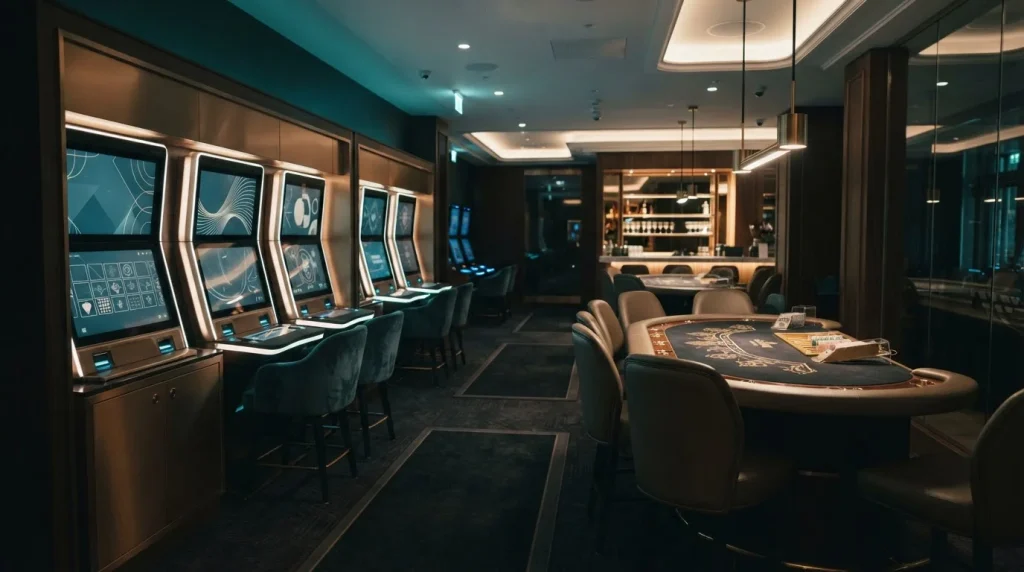
Neptune Play’s earlier British casino brought video slots, live dealer tables, computer-run table games and Slingo into an underwater-themed lobby. Its library changed over time: historical descriptions ranged from roughly 2,000 games to more than 3,500, while one inventory counted upwards of 2,200 slots. The broad mix belonged to the original casino, which stopped serving new British players by summer 2026. A historic game list helps explain the experience that players encountered; it is not a catalogue for a newly operating service.
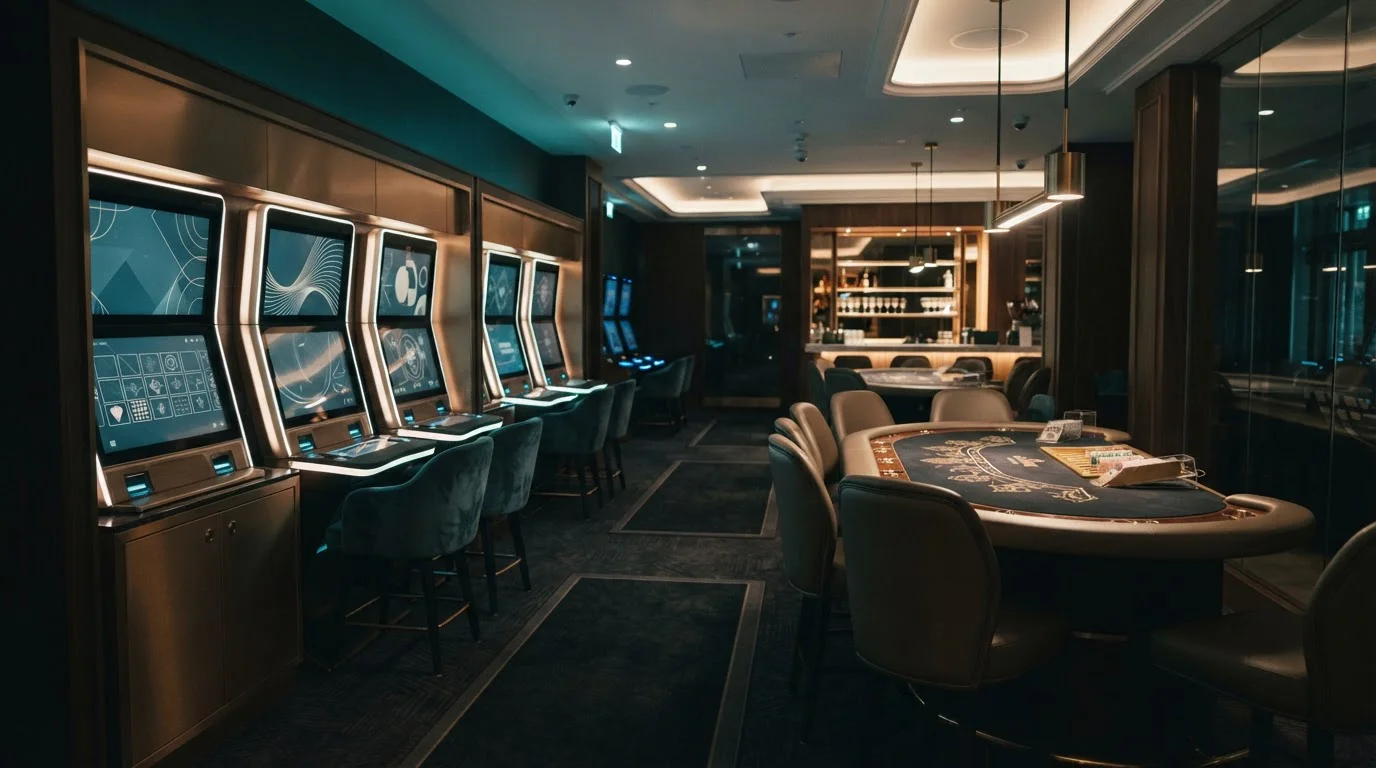
Table of Contents
- Table games and Slingo gave the library different rhythms
- Studios shaped the selection more than the lobby design
- Stake turnover explains exposure better than game count
- Video slots formed the broadest part of the old catalogue
- Live tables added a different pace and source of variation
- Frequently asked questions
- Slots, tables and Slingo defined the former game mix
Table games and Slingo gave the library different rhythms
Alongside its slot selection, the old Neptune Play platform included random-number-generator versions of blackjack, roulette and baccarat. A historic catalogue description counted more than 40 such table titles. These computer-run games used programmed results and on-screen controls rather than a person physically handling cards or a roulette wheel. The familiar game name alone did not mean every version shared the same rules, side bets or expected cost.
Slingo occupied a different corner of the earlier library. Around 40 Slingo games appeared in an old UK inventory, including Slingo Starburst, Slingo Centurion and Deal or No Deal Slingo. The format combines slot-style symbols and a bingo-like grid: a sequence of results is used to mark positions or complete patterns. As with other gambling games, a familiar puzzle structure does not turn the outcome into a skill contest or make a winning round predictable.
| Format | Historical examples | How the experience differed |
|---|---|---|
| Video slots | Book of Dead, Starburst, Big Bass Bonanza | Spins, symbol patterns and game-specific bonus features |
| Computer-run tables | Blackjack, roulette, baccarat | On-screen rule sets and RNG outcomes |
| Live dealer tables | Live blackjack, roulette and baccarat | Studio-hosted game flow and physical dealing |
| Slingo | Slingo Starburst, Slingo Centurion | Slot results combined with a grid-based game format |
| Live game shows | Game-show style tables | Presenter-led rounds with a different tempo |
The table distinguishes formats, not their odds. Two games presented in the same lobby can have very different payout distributions, betting limits and rules. Even within roulette, a version with extra side bets can produce a different financial profile from a straightforward wheel wager. For anyone looking back at a disputed wager, the exact game variant and round history matter more than a broad label such as “table game”.
In the old casino, these formats also met different promotional conditions. Slots were described as contributing fully to the previous welcome-match wagering requirement, while table-game contributions varied. The former bonus terms and game contribution rules show why wagering two equal sums in different formats could change the amount credited towards a promotional target.
Studios shaped the selection more than the lobby design
Neptune Play’s earlier games were supplied by multiple established software studios. Historical lists named NetEnt, Play’n GO, Pragmatic Play, Evolution, IGT, Quickspin, Hacksaw Gaming, Red Tiger, Games Global and Stakelogic. These names describe suppliers within the old catalogue. They do not imply that all their games were offered at the same time or that the same studios would populate any later version of the brand.
A provider develops the game rules, mathematical model, visuals and, in live casino, the studio experience. A casino lobby is the distribution layer that groups those titles into categories. That distinction explains why two casinos can carry the same game name while presenting it under different search filters, favourites menus or promotions. The underlying game version and its published information remain more relevant than the colour scheme around it.
- NetEnt and Play’n GO: suppliers associated with well-known video slots in the previous line-up.
- Pragmatic Play and Games Global: names that broadened the former slot categories and mechanics.
- Quickspin, Hacksaw Gaming, Red Tiger, IGT and Stakelogic: additional studios featured in historical provider lists.
- Evolution: a prominent source of live dealer tables, where a presenter or dealer appears through a video feed.
Having many studios can offer more choice in presentation and game mechanics. It does not in itself lower the house advantage, prove that an account is safe or guarantee the frequency of wins. A provider name is a way of identifying a title and its rule set; it is not a substitute for reading how a particular wager is settled.
A useful way to interpret an old session is to keep the studio name, full title and game type together. “Roulette” may be too vague to identify a round, while “live roulette from a named studio” points to a narrower set of dealing rules. For slots, a title with a particular suffix can denote a substantially different feature set from the original game. Accurate naming improves the interpretation of play history without implying access to those games now.
Stake turnover explains exposure better than game count
A catalogue with several thousand games tells you about variety, not the cost of a session. The important money variables are the stake per round, the number of rounds and the mathematical advantage built into a particular game. Slots can move quickly between rounds; table games may involve rule decisions and optional side wagers; Slingo uses its own sequence of turns. The amounts staked, rather than the number of titles in a lobby, determine the scale of money put at risk.
Consider a purely illustrative session: 100 rounds at £1 each create £100 in total stakes. If a hypothetical game had a 2% mathematical house edge, its theoretical expected loss over those stakes would be £2. This is not a Neptune Play RTP, a quoted figure for any historical game or a prediction that a player finishes £2 down. In any one session the outcome can vary widely; wins, losses and larger features make short-run results uneven.
Doubling the number of rounds to 200 at the same £1 stake doubles the illustrative turnover to £200 and the 2% expected loss to £4. Raising the stake instead to £2 over 100 rounds produces that same £200 turnover. Those examples demonstrate how exposure can grow through speed or bet size while a game’s theoretical edge stays constant. They do not suggest that a particular sequence of wins and losses should follow the average.
- Start with the individual stake: this measures what one completed round can put at risk.
- Count all the rounds: turnover is the sum of stakes, including repeated use of winnings.
- Separate turnover from a deposit: £100 of bets can occur using less than £100 in original deposits if funds are repeatedly recycled.
- Use the game’s own information: a single illustrative edge cannot replace rules for a slot, table variant or Slingo title.
RTP, or return to player, is usually a long-run mathematical measure attached to a game configuration. It cannot tell someone what the next spin will return. Volatility concerns how unevenly wins arrive, and two games with similar long-run returns may produce very different experiences in a short session. A progressive jackpot creates another kind of variation: an occasional large prize can influence a game’s overall distribution, while most individual rounds will not produce it.
These concepts are also useful when interpreting promotional play. A wagering requirement specifies how much eligible staking activity is needed; it does not limit losses to a fixed amount. That is why a player’s remaining balance, total turnover and theoretical game return must be kept separate in any account of the old platform.
Video slots formed the broadest part of the old catalogue
Slots dominated the older Neptune Play inventory. One UK snapshot counted over 2,200 slot titles within a wider collection of casino games. Named examples included Book of Dead, Starburst, Big Bass Bonanza, Gates of Olympus, Gemix 2 and Piggy Riches 2 Megaways. The lists capture a period in the original casino’s life, not a fixed inventory that carried forward unchanged.
Those titles also show why “slot” describes a category rather than one uniform experience. Some games emphasise simple paylines and repeated base-game spins; others use expanding symbol grids, free-spin features, different reel mechanisms or bonus rounds. Megaways is a recognisable format with changing ways to form combinations. Progressive-jackpot games link part of the appeal to a prize pool whose size can change, but their presence does not indicate that a player is likely to receive that prize.
From the player’s point of view, a larger shelf of slot titles brings more user-interface choice: themes, controls, denominations and features can differ. The economic side still depends on each game’s rules. A title can look visually calm yet have sharp variations in the value of individual wins. A colourful feature animation can also accompany a small payout. Neither presentation nor provider count is a reliable proxy for lower risk.
Slot examples are best kept together with the date and game version when revisiting historic play. A named title may have appeared in several variants or versions, and a feature purchased or triggered in one version might not behave like a feature in another. A screenshot of a lobby category would not settle the details of an individual round. The useful record is the title, stake, round sequence and the account transaction attached to it.
The former service was also accessed through a responsive web interface on mobile browsers. A long slot catalogue displayed on a phone could be reorganised by filters and search, but a mobile layout did not change the underlying game rules. The earlier mobile-browser and account experience places that game access in the context of the original platform rather than a promised contemporary app.
Live tables added a different pace and source of variation
The historic Neptune Play live casino carried dealer-hosted blackjack, roulette and baccarat, as well as presenter-led game-show formats. One older UK description counted more than 100 live games. Evolution appeared among the named suppliers. The attraction of the format was the streamed studio setting: real dealing or wheel action unfolded on video while players used a digital interface to place and settle bets.
The main distinction from an RNG table is how the outcome is produced. A computer-run roulette game uses a random-number generator; a live roulette game follows a physical wheel in a studio. Both still require the player to understand the wager and its payout rules. Neither a human presenter nor a realistic camera view eliminates the house advantage or guarantees a fair individual result.
Live sessions may be paced by a dealer and betting window rather than by a player’s rapid taps. That can change the number of completed rounds during a fixed period, which in turn changes total stake turnover. It does not necessarily lower the amount at risk per hand. Side bets and multiple betting positions can also increase the total wager within one round without changing the visible base-game name.
Historical lists grouped together traditional tables and more theatrical game-show products. The latter may use presenters, wheels, special rounds or multipliers. Their rules can differ widely from standard blackjack or baccarat. For a past win or loss, it is therefore more useful to identify the precise game and bet position than to say that it occurred somewhere in the live section.
The old catalogue’s breadth came from combining three kinds of experience: fast solo slot rounds, computer-run table play and scheduled dealer-led rounds. Slingo added a grid-based variation. That variety explains why the former casino appealed to different preferences, but it carries no promise about current access, account balances, payout timing or the safety of staking money.
Frequently asked questions
Did Neptune Play feature live blackjack and roulette?
Yes. The former casino included live blackjack and roulette, alongside baccarat and live game-show tables. These are features of the earlier casino catalogue.
Which studios supplied Neptune Play games?
The former catalogue included NetEnt, Play'n GO, Pragmatic Play, Evolution, IGT, Quickspin and other named suppliers.
Did Neptune Play include Slingo?
Yes. The earlier library featured roughly 40 Slingo titles, including Slingo Starburst, Slingo Centurion and Deal or No Deal Slingo.
How many games did Neptune Play have?
Historical descriptions put the catalogue broadly between about 2,000 and more than 3,500 games, depending on period and count; that is not a live inventory.
Slots, tables and Slingo defined the former game mix
Neptune Play’s original UK casino was built around a wide slot library supported by named studios, live dealer tables, RNG alternatives and a recognisable Slingo selection. It brought together different play rhythms under one lobby. The game counts, provider names and examples describe that earlier product, not a new inventory.
The enduring lesson from that mix is practical: a game category tells you how play is presented, while the specific rules, stake and number of rounds determine the financial exposure. Thousands of choices do not change that distinction. For a historical session, an exact title and transaction history are more informative than a headline catalogue count.